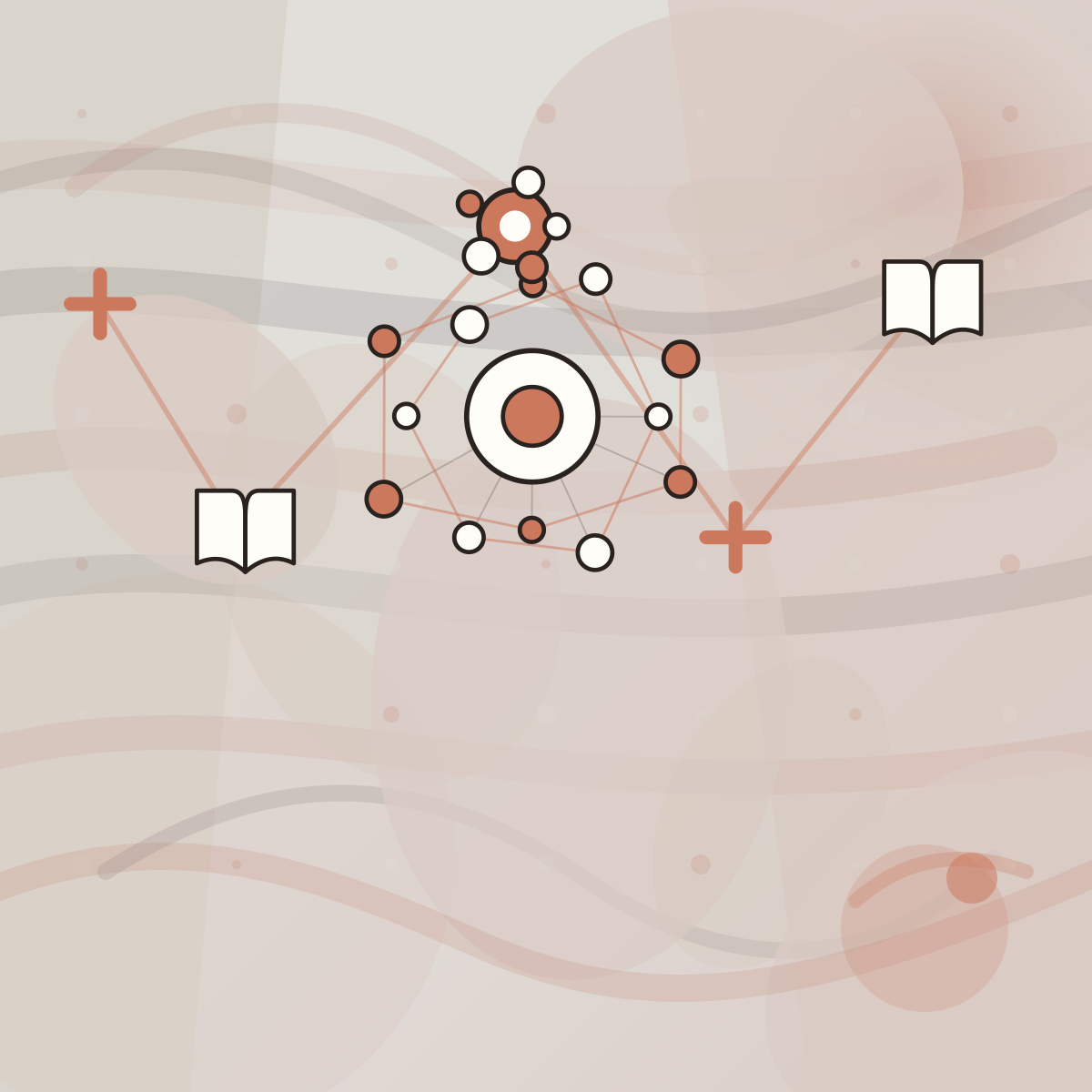
Editorial illustration of global health, education, and research programs connected by AI support
+ Anthropic News

Anthropic and the Gates Foundation commit $200 million to AI public-good work

Anthropic's May 14 Gates Foundation partnership directs funding, Claude credits, and technical support toward global health, life sciences, education, and economic mobility.

Anthropic and the Gates Foundation announced a $200 million partnership on May 14, 2026, focused on global health, life sciences, education, and economic mobility. The commitment includes grant funding, Claude usage credits, and technical support over four years.

This is a different kind of AI deployment story. It is not aimed first at enterprise productivity or consumer usage. It is aimed at fields where market incentives alone may not push advanced AI toward the people who need it most.

What changed

Anthropic says the work will be implemented with partners in the U.S. and around the world. Its Beneficial Deployments team will provide Claude credits and engineering support, while also developing public goods such as public health datasets and evaluation benchmarks.

That combination matters: money, model access, technical help, and evaluation infrastructure are all needed if nonprofit and public-interest users are going to do more than run isolated pilots.

Why this matters

The AI public-good problem is not just “who gets access?” It is who gets usable, supported, evaluated systems for domains where mistakes have consequences.

Health, education, and economic mobility work often depends on local context, privacy, language, and institutional constraints. A model credit alone will not solve that. Technical support and benchmark development are the more serious parts of the announcement.

What to watch next

Watch the first funded programs and whether their outputs are reusable by other organizations. The strongest version of this partnership would create public datasets, evaluations, and implementation patterns that outlast any single grant.

Sources

The AI Feed Desk

The AI Feed Desk

Editorial desk

The AI Feed Desk tracks AI provider updates, model releases, agent tooling, and enterprise adoption, turning fast-moving announcements into source-linked context for builders and operators.

Noticed a typo, incorrect information, or translation error?

Tell us so we can fix it.

Help Improve This Article

Related Articles

Anthropic's Stainless acquisition brings Claude closer to the API layer

Anthropic's May 18 acquisition of Stainless gives Claude Platform deeper control over SDKs, CLIs, and MCP server tooling, showing how agent competition is moving into API connectivity.

The AI Feed Desk

By The AI Feed Desk

Google I/O 2026 makes Gemini the operating layer for agents

Google's May 19 I/O updates put Gemini 3.5 Flash, Gemini Spark, Android automation, and Universal Cart into one agent strategy across apps, devices, developer tools, and commerce.

The AI Feed Desk

By The AI Feed Desk

OpenAI says its model disproved an 80-year geometry conjecture

OpenAI's May 20 unit-distance proof gives AI research a concrete milestone: a model-generated result checked by mathematicians, with human verification still central.

The AI Feed Desk

By The AI Feed Desk

Claude for Small Business turns agent workflows into a toggle install

Anthropic's May 13 Claude for Small Business release packages 15 workflows and connectors for QuickBooks, PayPal, HubSpot, Canva, Docusign, Google Workspace, and Microsoft 365.

The AI Feed Desk

By The AI Feed Desk

KPMG is embedding Claude into Digital Gateway and 276,000 employee workflows

Anthropic's May 19 KPMG alliance puts Claude inside Digital Gateway, tax and legal tools, and a global workforce, showing enterprise AI moving into owned workflow software.

The AI Feed Desk

By The AI Feed Desk