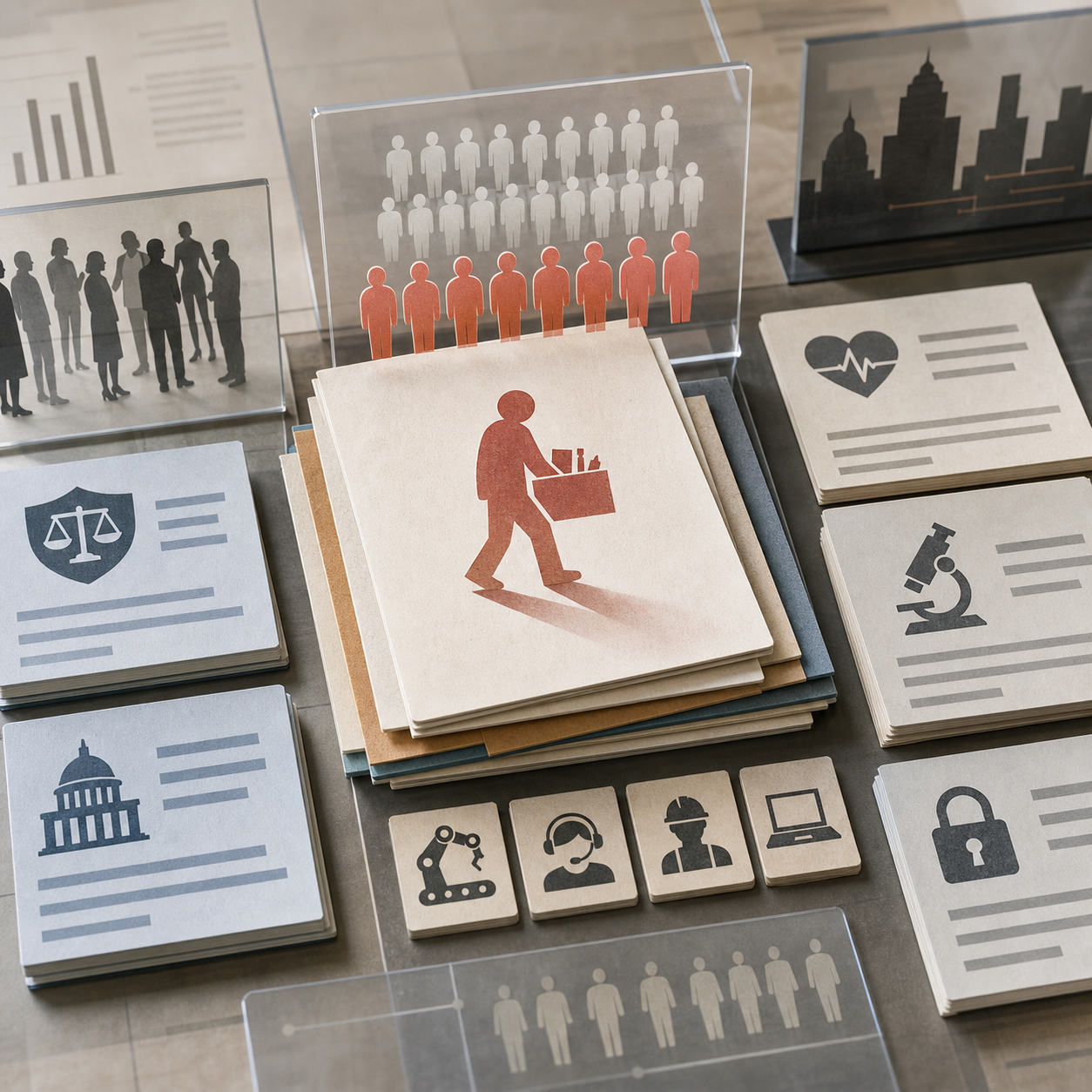
Anthropic published the first results from its Public Record project on June 12, 2026, and the clearest finding is not subtle: job loss is the most common AI fear in every US state. Anthropic reports that 64% of Americans are worried AI will displace jobs, while only 15% trust AI companies to make decisions about how AI is developed and used.
That is useful because it turns the policy debate into numbers. The public is not simply anti-AI. Anthropic says nearly half of Americans ranked curing diseases such as cancer or Alzheimer’s as one of their top three hopes for AI. But the same survey shows broad demand for accountability, legal liability, and some government role in regulation.
Job loss is the common denominator
Anthropic says job-displacement concern is broad across party, geography, and household type. It reports that 67% of Democrats and 62% of Republicans are worried about AI displacing jobs, and that the concern is the top-ranked fear in every state. The range runs from Iowa at 71% to Mississippi at 57%.
The pattern is important because it does not fit a simple partisan story. If job loss is the shared fear, AI policy will not be shaped only by frontier-model safety debates or platform competition. It will also be shaped by labor-market anxiety from people who think AI can affect their work directly.
Anthropic’s more interesting detail is that concern is lower among people who use AI at work every day. The company reports a 54% worry rate among daily workplace AI users, compared with 70% among people who do not use AI at all. Anthropic offers possible explanations: hands-on experience may show both the usefulness and the limits of the technology. That is an interpretation, not a settled causal claim.
The trust gap is the policy signal
The survey’s trust finding is sharper than the job-loss number. Only 15% of Americans said they trust AI companies to make decisions about how AI is developed and used. Anthropic also reports that Americans ranked holding AI companies legally liable for harm and prioritizing safety over growth as the highest-leverage ways to ensure AI benefits humanity.
That is a difficult message for labs. The public may want AI for medicine, accessibility, productivity, and research, but it does not want the companies building those systems to be the only decision-makers. The practical read is that voluntary safety statements will not be enough to satisfy a broad public-accountability demand.
The current policy backdrop makes that more relevant. AP reported this week that states are still moving ahead with AI laws despite federal efforts to limit state-level regulation, with measures focused on areas such as children, chatbots, employment, transparency, and bias prevention. Anthropic’s numbers explain why that pressure is hard to suppress: voters may disagree on federal policy, but many share concern about jobs, privacy, child safety, and liability.
The hope side still matters
The survey is not a rejection of AI. Anthropic says 48% of Americans ranked curing diseases like cancer or Alzheimer’s as one of their top hopes for AI. Helping people with disabilities came next at 36%, followed by technological progress and making life easier in general, both at 23%.
That mix is the article’s main tension. People want high-upside outcomes and stronger guardrails at the same time. They are not asking for AI to disappear. They are asking for more evidence that the benefits will be shared and that harms will have accountable owners.
The counter-case is that the Public Record is Anthropic’s own survey program. The findings are still useful, but readers should look for the full methodology, questionnaire, sample details, and future waves before treating the numbers as a complete map of US opinion. The most responsible use is directional: job displacement, accountability, and government involvement are central public concerns.
What to watch next
The next checkpoint is whether labs use surveys like this as policy evidence or as product feedback. If the public is most worried about jobs, an AI company cannot answer only with model cards and safety evals. It needs clearer evidence about labor effects, retraining, liability, and where humans stay in control.
For readers tracking how these concerns connect back to model capability and company strategy, see our AI model leaderboard and AI company tracker.