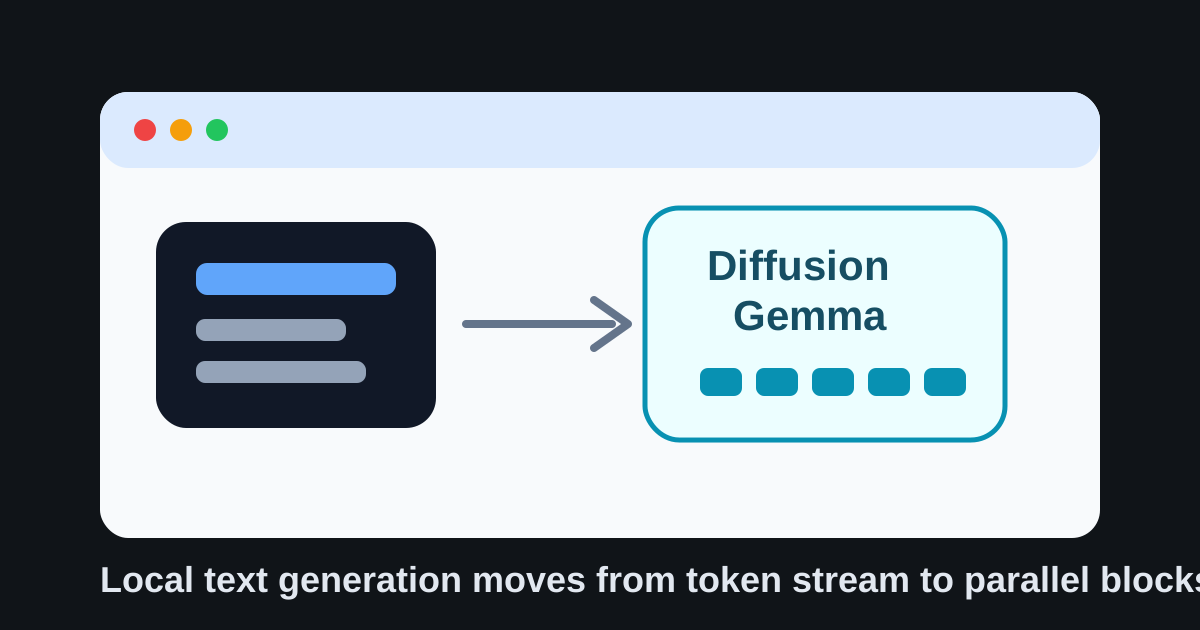
Google released DiffusionGemma on June 10, 2026. It is an experimental open text-generation model that uses diffusion-style generation instead of the usual left-to-right token stream. Google says the model generates up to 4x faster on dedicated GPUs by drafting blocks of text in parallel.
The release is interesting because it changes the latency problem. Most local language models feel slow because each token waits on the previous token. DiffusionGemma tries to make a local GPU do a larger chunk of work at once. That is useful for interactive editing, code infilling, agent loops, and other single-user workflows where batching thousands of requests in the cloud is not the point.
The speed claim is local and specific
Google’s headline claim is not that diffusion text generation replaces every large language model. It is narrower: DiffusionGemma is designed for low-latency, low-to-medium batch, local generation. The post says the model reaches 1000+ tokens per second on a single NVIDIA H100 and 700+ tokens per second on an NVIDIA GeForce RTX 5090.
That distinction matters. Cloud providers can make autoregressive models efficient by batching many users together. A developer running a local assistant, editor, or agent on one machine does not have that same traffic pattern. In that setting, the decode bottleneck is felt directly by the user.
DiffusionGemma attacks that problem by generating a block of text together. Google says each forward pass can handle 256 tokens in parallel, with tokens able to attend to one another inside the block. That is why Google points to non-linear tasks such as inline editing, code infilling, amino acid sequences, and mathematical graphs as good places to test the model.
The trade-off is quality
Google is unusually clear about the caveat. DiffusionGemma is built for speed-critical interactive workflows, not maximum output quality. The company says standard Gemma 4 models remain the recommendation for applications that demand the best production output.
That makes the product boundary cleaner. DiffusionGemma is not a new all-purpose local champion. It is a test bed for workflows where response shape and latency matter as much as raw answer quality. A code editor that needs fast infill, a local agent that needs to iterate quickly, or a UI that previews structured text could benefit even if a slower autoregressive model wins on harder reasoning.
For teams evaluating it, the first question should be whether the model’s answers are good enough for the interactive loop. If the user has to repair every fast answer, the latency win disappears. If the task is constrained enough that the model can self-correct within the block, the speed change becomes meaningful.
NVIDIA wants the workload on local GPUs
NVIDIA published a same-day post saying it optimized DiffusionGemma for GeForce RTX GPUs, RTX PRO workstations, DGX Spark, DGX Station, and H100-class systems. NVIDIA frames the model as a better match for GPU compute because diffusion pulls a full text block through the transformer in parallel instead of waiting on memory-bound token-by-token generation.
The hardware list is part of the story. Google says DiffusionGemma can fit within 18GB of VRAM on high-end consumer GPUs when quantized. NVIDIA says the model has day-zero support in Hugging Face Transformers, vLLM, and Unsloth, with llama.cpp support coming soon.
That is the adoption path to watch. Local models do not spread only because the weights exist. They spread when the runtime stack makes them easy to test. If DiffusionGemma runs smoothly in the tools local-model developers already use, it gets a real shot at becoming a benchmark for text-diffusion workflows.
What to test first
Start with tasks that punish sequential decoding. Inline editing, structured rewrites, partial code completion, and fast multi-step agent loops are better tests than open-ended essays. DiffusionGemma’s advantage is supposed to appear when the model can use bidirectional context across a generated block.
Then test quality side by side with standard Gemma 4. The useful comparison is not only tokens per second. It is accepted output per minute: how many generated blocks can a user keep with little or no repair?
Finally, test the actual runtime. Compare Transformers, vLLM, Unsloth, and any local inference stack that supports the model. DiffusionGemma’s architecture may shift the bottleneck, but the user’s experience still depends on kernels, quantization, memory, and the surrounding app.
For broader model context, see our AI model leaderboard. For related company coverage, see Google and NVIDIA.