Google says Apple developers can now wire cloud-hosted Gemini models into Apple apps through the Foundation Models framework, with Gemini also integrated into Xcode for coding tasks.
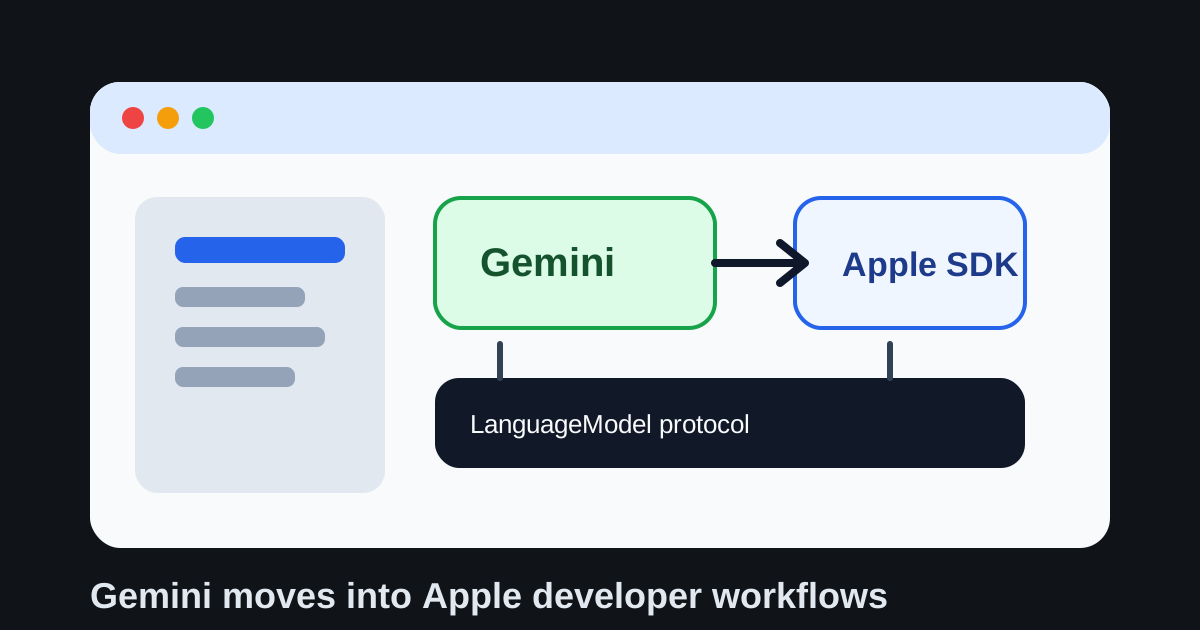
The product detail matters because it puts third-party models behind an Apple-native developer interface. Starting with iOS 27, macOS 27, iPadOS 27, visionOS 27, and watchOS 27, Google says model providers can implement Apple’s public LanguageModel protocol. Gemini is the first concrete example Google is advertising: developers can access it through the Firebase Apple SDK and Firebase AI Logic.
Apple is opening a model slot
Apple’s platform story is usually tight: native frameworks, native controls, native defaults. Google’s post shows Apple opening a slot in that system for external cloud model providers.
The practical change is a shared interface. If a developer is already using Apple’s Foundation Models framework, Google says switching to Gemini can be a small model-instance change. That does not make local and cloud inference identical. It does make the routing decision easier to express in app code.
That matters for agentic apps. Some tasks are cheap and private enough to run on device. Others need a larger cloud model, current context, or more reasoning depth. A common interface lets an app choose the model path without forcing the developer to build a separate backend for every call.
Firebase is the access path
Google is not just saying “use the Gemini API.” It is making Firebase the bridge for Apple developers.
The post says the integration is based on Firebase AI Logic, which lets developers add Gemini to iOS, macOS, iPadOS, and visionOS apps without maintaining a separate backend server. Google also points to Firebase App Check as the abuse-control layer for service APIs used to access Gemini models.
That is the operational piece. Client apps that call cloud models need quota, authentication, abuse controls, and a way to keep model keys out of casual extraction paths. Google is packaging those concerns into Firebase rather than asking every Apple developer to invent the same plumbing.
Xcode becomes another model surface
Google also says it worked with Apple to integrate Gemini into Xcode. Developers configure it through Xcode’s Intelligence settings panel, then use Gemini for multi-step tasks such as reviewing code, fixing bugs, and building features.
That is a separate distribution path from app runtime inference. Runtime Gemini helps developers ship AI features to users. Gemini in Xcode helps developers write the app itself. Both matter because Apple developer adoption depends on workflow convenience as much as model quality.
There is also an enterprise split. Google says individual developers can use self-serve Gemini API keys from Google AI Studio, while enterprise developers can use Gemini Enterprise Agent Platform for corporate quotas and data privacy parameters. That is the right split for a tool that may touch proprietary source code.
The real test is routing
The strong version of this story is not “Gemini comes to Apple.” Gemini was already reachable through APIs. The stronger version is that Apple developers get a cleaner routing model: local Apple inference when it is enough, cloud-hosted Gemini when it is useful, Xcode assistance when the developer is building.
The open questions are the ones teams should test: latency, supported model list, cost controls, App Store review expectations, data-handling defaults, and how much control developers get when choosing between local and hosted models.
If Apple keeps making the model layer pluggable while preserving native app ergonomics, AI features on Apple platforms may stop being an Apple-only model story. They become a framework story, and Google is moving early to occupy that slot.
For live model comparisons, see The AI Feed models page. For related company coverage, see Google and Apple.