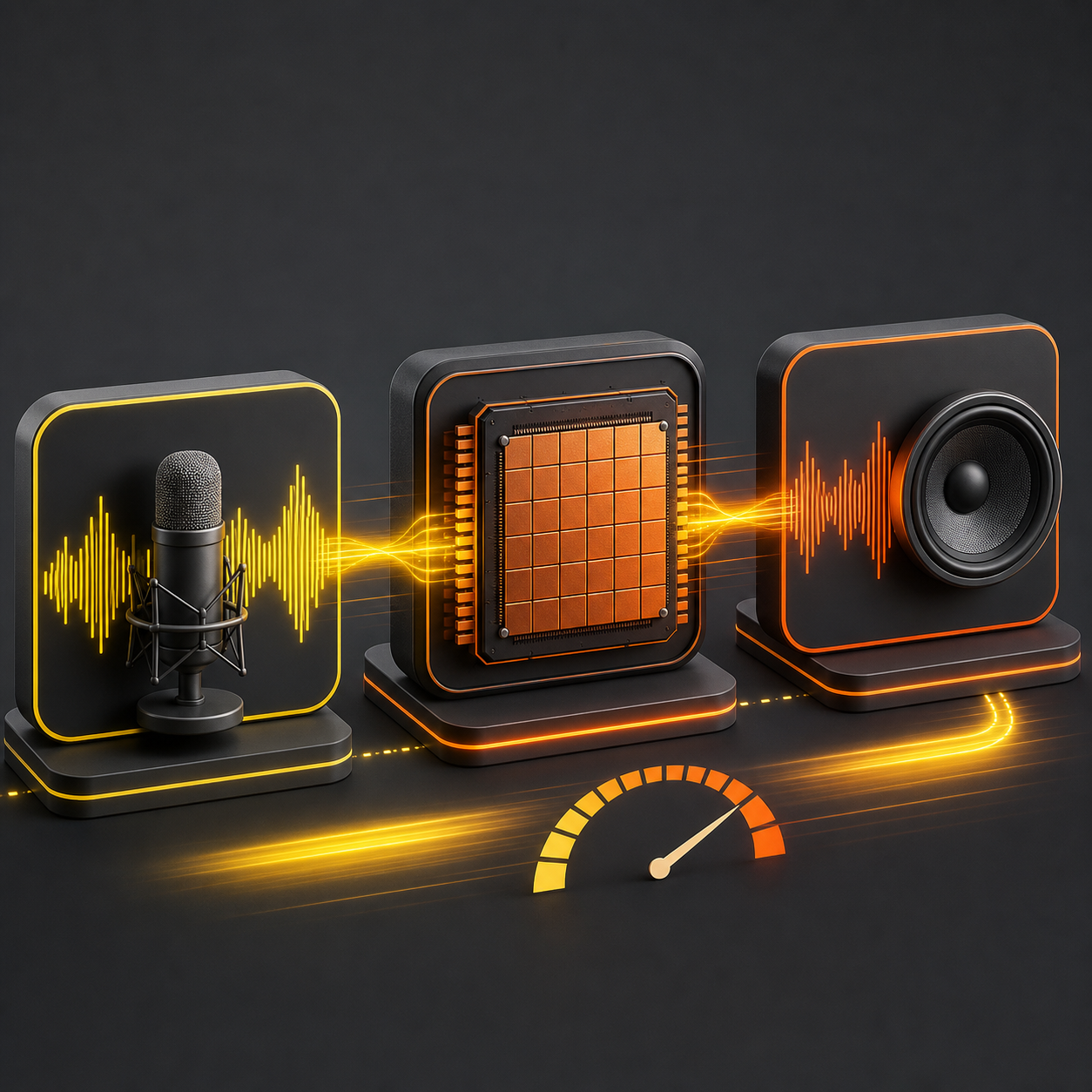
Hugging Face and Cerebras published an open speech-to-speech demo on July 1 that connects Nvidia Parakeet for speech recognition, Gemma 4 VLM running on Cerebras for the language-model step, and Alibaba’s Qwen3TTS for speech output.
The story is not that a voice assistant exists. The useful point is where the demo puts the latency fight.
In a speech-to-speech system, a user feels delay as one continuous pause. Under the hood, that pause comes from several stages: audio capture, speech recognition, language-model inference, text-to-speech generation, transport, and playback. Hugging Face and Cerebras are arguing that open models can participate in that loop if the language-model step gets fast enough.
The stack is modular
The post describes a modular pipeline rather than a single proprietary assistant. Speech comes in through Parakeet. The language-model response runs through Gemma 4 VLM served by Cerebras. Qwen3TTS turns the answer back into speech.
That modularity matters for open voice AI. A team can swap pieces, measure bottlenecks, and choose different trade-offs for transcription quality, model behavior, latency, language coverage, voice quality, and deployment cost.
The article also links the work to Reachy Mini robots. Hugging Face says the same stack powers voice capabilities on those robots and that more than 9,000 Reachy Minis are in the wild. That makes the demo more concrete than a browser toy, though it still should not be treated as a blanket production-readiness claim.
Latency changes product behavior
Voice AI is less forgiving than chat. A text assistant can take a few seconds and still feel usable. A spoken assistant that pauses too long breaks the rhythm of conversation.
That is why inference speed is not only a technical brag. It changes what users will tolerate. If the model step has a long tail, the assistant feels hesitant or broken even when the final answer is good. If the model step is fast, the rest of the pipeline has room for better speech recognition, safer tool calls, or more natural audio output.
The Hugging Face/Cerebras post does not give enough timing data to turn the article into a benchmark. It does give a useful architecture signal: open speech-to-speech systems are moving from “can it work?” toward “which stage is slow, and how do we swap it?”
Open does not remove the integration work
The stack is still a system. A good voice agent needs turn detection, interruption handling, audio cleanup, safe tool use, context management, privacy rules, and product-specific evaluation. Fast inference helps, but it does not solve those problems by itself.
For developers, the practical opportunity is experimentation. A modular stack makes it easier to compare speech recognition models, language models, inference providers, and TTS systems without rebuilding the whole assistant.