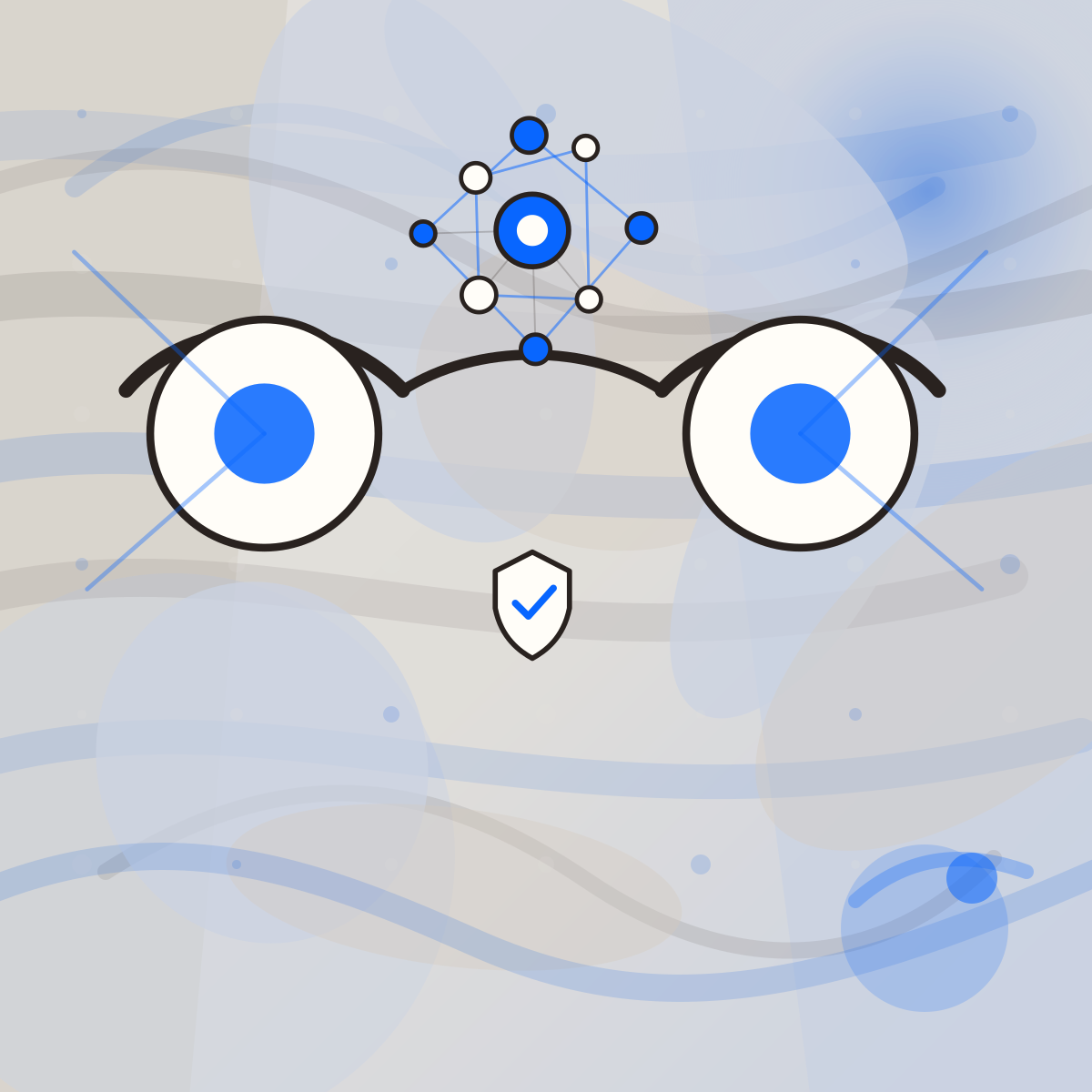
Editorial illustration of AI glasses sensing nearby objects and assistive signals
+ Meta News

Meta is turning AI glasses into an accessibility developer platform

Meta's May 18 accessibility update adds Be My Eyes improvements, voice controls, shortcuts, captions, and a Device Access Toolkit for third-party AI glasses apps.

Meta’s May 18, 2026 update on AI glasses is more than a feel-good accessibility story. It shows the company turning glasses into a developer platform for assistive experiences.

Meta says its Wearables Device Access Toolkit gives developers resources to build third-party apps for AI glasses that help people with disabilities navigate daily life with more independence.

What changed

Meta is adding group calling and Service Directory support with Be My Eyes, voice controls during calls, one-touch shortcuts, and real-time captions during voice calls on Meta Ray-Ban Display glasses. It also describes third-party experiences such as OOrion for locating objects and reading text, and Aira for professional visual interpretation.

The company is also exploring EMG control through a Carnegie Mellon University partnership, using muscle signals for people with spinal cord injuries.

Why this matters

AI glasses become much more credible when they solve physical-world problems that phones handle poorly. For blind, low-vision, and mobility-disabled users, hands-free context can be genuinely useful.

The trust bar is high. Assistive technology has to be reliable, private, and fast enough to use in the world. A slow or wrong answer in a demo is awkward; a wrong answer during navigation can be dangerous.

What to watch next

Watch the third-party toolkit. If developers can build high-quality assistive apps on glasses, the category becomes more than a camera and chatbot on your face. It becomes a platform for context-aware accessibility.

Sources

The AI Feed Desk

The AI Feed Desk

Editorial desk

The AI Feed Desk tracks AI provider updates, model releases, agent tooling, and enterprise adoption, turning fast-moving announcements into source-linked context for builders and operators.

Noticed a typo, incorrect information, or translation error?

Tell us so we can fix it.

Help Improve This Article

Related Articles

Anthropic's Stainless acquisition brings Claude closer to the API layer

Anthropic's May 18 acquisition of Stainless gives Claude Platform deeper control over SDKs, CLIs, and MCP server tooling, showing how agent competition is moving into API connectivity.

The AI Feed Desk

By The AI Feed Desk

Google I/O 2026 makes Gemini the operating layer for agents

Google's May 19 I/O updates put Gemini 3.5 Flash, Gemini Spark, Android automation, and Universal Cart into one agent strategy across apps, devices, developer tools, and commerce.

The AI Feed Desk

By The AI Feed Desk

OpenAI says its model disproved an 80-year geometry conjecture

OpenAI's May 20 unit-distance proof gives AI research a concrete milestone: a model-generated result checked by mathematicians, with human verification still central.

The AI Feed Desk

By The AI Feed Desk

Claude for Small Business turns agent workflows into a toggle install

Anthropic's May 13 Claude for Small Business release packages 15 workflows and connectors for QuickBooks, PayPal, HubSpot, Canva, Docusign, Google Workspace, and Microsoft 365.

The AI Feed Desk

By The AI Feed Desk

KPMG is embedding Claude into Digital Gateway and 276,000 employee workflows

Anthropic's May 19 KPMG alliance puts Claude inside Digital Gateway, tax and legal tools, and a global workforce, showing enterprise AI moving into owned workflow software.

The AI Feed Desk

By The AI Feed Desk