NVIDIA says its Blackwell platform delivered the fastest time to train on every benchmark in MLPerf Training 6.0, the latest round of the industry benchmark suite for AI training systems. The June 16, 2026 post says NVIDIA was also the only platform submitted across all seven benchmarks in the suite.
This is not a consumer-model story. It is a systems story. The workloads now include large mixture-of-experts and dense language-model training tasks, and NVIDIA is using the results to show that frontier training depends on rack-scale design, networking, low-precision methods, and reliability, not just individual accelerator speed.
The benchmark is moving toward frontier workloads
NVIDIA says MLPerf Training 6.0 added two mixture-of-experts pretraining workloads: DeepSeek-V3 671B and GPT-OSS-20B. That is the important change. Modern frontier training is not only a dense-model scaling exercise. MoE models route tokens across expert subnetworks, which makes communication between GPUs a central constraint.
That is why NVIDIA spends so much of the post on NVLink, rack-scale systems, InfiniBand, Spectrum-X Ethernet, and NVFP4 training. The claim is not just “the chips are faster.” It is that the platform can keep large training jobs moving when the model, data, and communication pattern are all difficult.
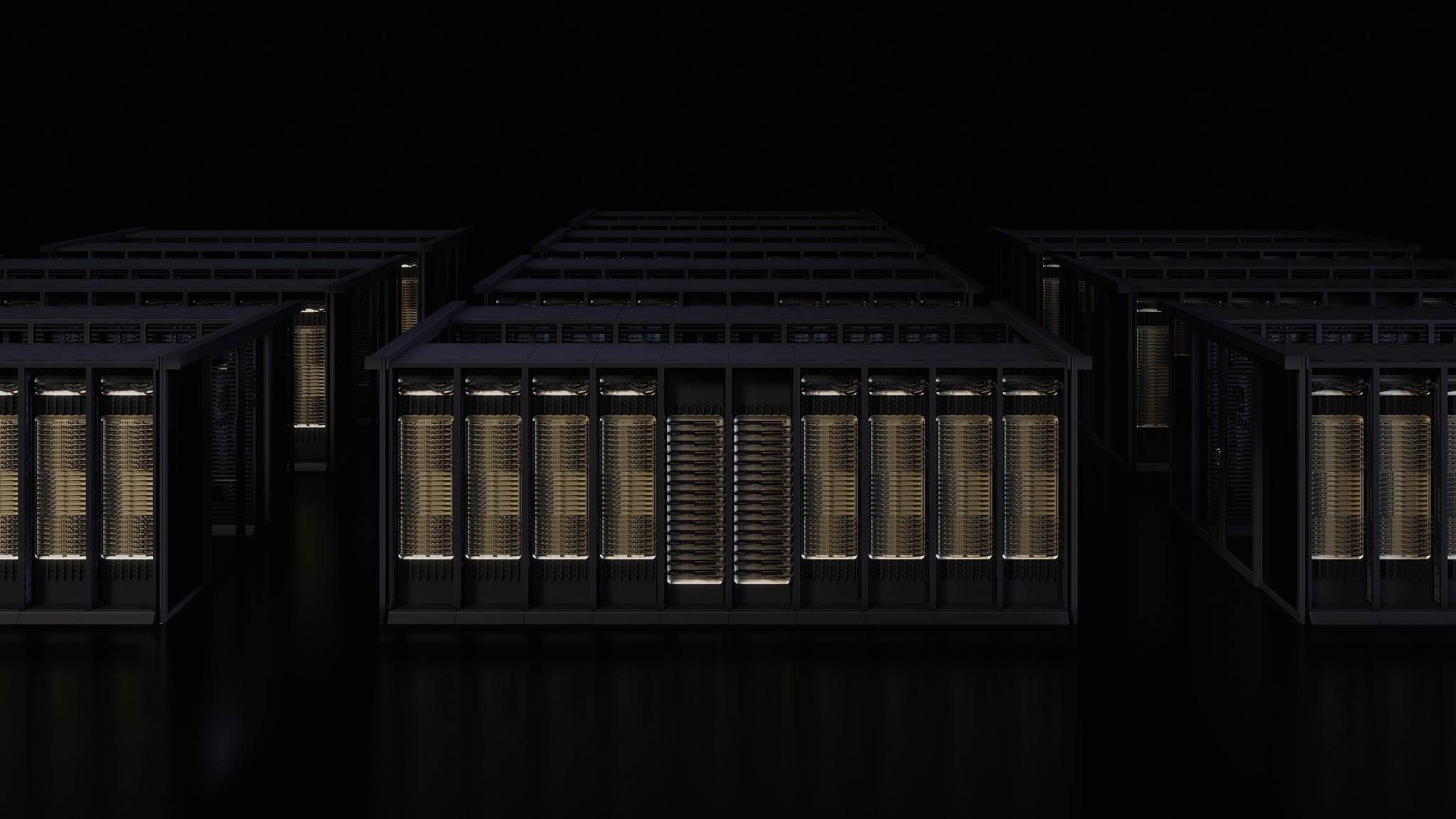
The largest figure in the post is the 8,192-GPU DeepSeek-V3 671B submission using GB200 NVL72 systems. NVIDIA also says it submitted a 5,120-GPU result on Llama 3.1 405B, one of the largest dense LLMs in the suite.
Partner results show what cloud buyers care about
The partner details are the most useful part for infrastructure buyers. NVIDIA says Microsoft Azure scaled Llama 3.1 405B training to 8,192 GPUs using GB200 NVL72 systems and reached the reference quality target in 7.07 minutes, which NVIDIA describes as the fastest time to train for that benchmark.
It also says CoreWeave delivered the fastest time to train DeepSeek-V3 671B, reaching the quality target in 2.02 minutes at 8,192-GPU scale using GB300 NVL72 systems with Spectrum-X Ethernet networking.
Those are benchmark numbers, not a procurement recommendation by themselves. They do show where the contest is moving. Cloud providers and dedicated AI clouds have to prove not only that they can buy accelerators, but that they can make giant clusters train reliably at full scale.
Reliability is part of the pitch
NVIDIA’s post pairs performance with reliability because training failures are expensive. A frontier run can last weeks or months, and a cluster problem can waste compute or force a restart. NVIDIA points to chip screening, reliability monitoring, self-healing capabilities, Spectrum-X rerouting, and NVRx checkpoint recovery as part of the production story.
That framing is useful. A training benchmark that finishes in minutes does not by itself tell a lab how the system behaves across months of training, failed nodes, network events, or software updates. But it does put reliability into the same conversation as speed, which is where it belongs for frontier training.
The counter-case is obvious: this is NVIDIA describing NVIDIA results. MLPerf is a structured benchmark, but the article is still vendor evidence. Buyers should look for independently comparable submissions, configuration details, power assumptions, and total system cost before drawing economic conclusions.
What changes for model builders
For model labs, the lesson is that architecture choices and infrastructure choices are now tightly coupled. A model that uses mixture-of-experts routing stresses the network differently from a dense model. A training plan that depends on low-precision methods depends on software maturity. A cloud deal that looks good per GPU can fail if the cluster cannot sustain long runs.
For the AI market, Blackwell’s MLPerf showing reinforces a theme already visible in agentic inference benchmarks: the unit of competition is becoming the full system. GPUs, networking, rack design, serving software, training libraries, checkpointing, and operations all determine whether a model can be trained or served economically.
The next checkpoint is whether other vendors and cloud providers publish enough comparable MLPerf and production details to make this a real buyer’s market rather than a set of impressive one-company claims.
For readers tracking infrastructure and model economics, see our AI model leaderboard and AI company tracker.