OpenAI published economic research on June 25 that frames Codex as more than a coding assistant. The company says Codex has become the primary AI tool used by every department inside OpenAI, including legal, finance, recruiting, support, research, and operations.
The numbers are unusually concrete for an agent-adoption story. By May 2026, OpenAI says 80.6% of sampled individual Codex users had made at least one request estimated to represent more than 30 minutes of human work. 70.2% had made at least one request estimated above one hour, and 25.6% had made one estimated above eight hours.
That makes the story less about prompt volume and more about delegated work. OpenAI’s claim is that agents change the unit of work from a single answer to a task that can run for minutes or hours.
The adoption curve moved past engineers
OpenAI says engineers adopted Codex first, which is expected for a tool that began around software work. The more interesting shift is that non-developer adoption grew faster from a smaller base.
Since August 2025, OpenAI reports that non-developer users rose 137x among individual users, 189x among organizational users, and 12x inside OpenAI. Within OpenAI, legal, finance, and recruiting crossed into majority Codex use around April 2026. The company says the average lawyer or recruiter now generates more than 85% of output tokens on Codex.
This does not mean every non-technical worker has become a software engineer. It means the boundary around technical execution is moving. OpenAI’s occupational heat map shows business functions using Codex for knowledge work, analysis, and also a meaningful amount of engineering or coding work.
That is the practical enterprise signal. If agents can handle automation, data transformation, debugging, internal tooling, and structured analysis, departments that used to wait for engineering support can begin doing adjacent technical work themselves.
Long tasks are the important threshold
The most useful metric in the post is not token share. It is task horizon.
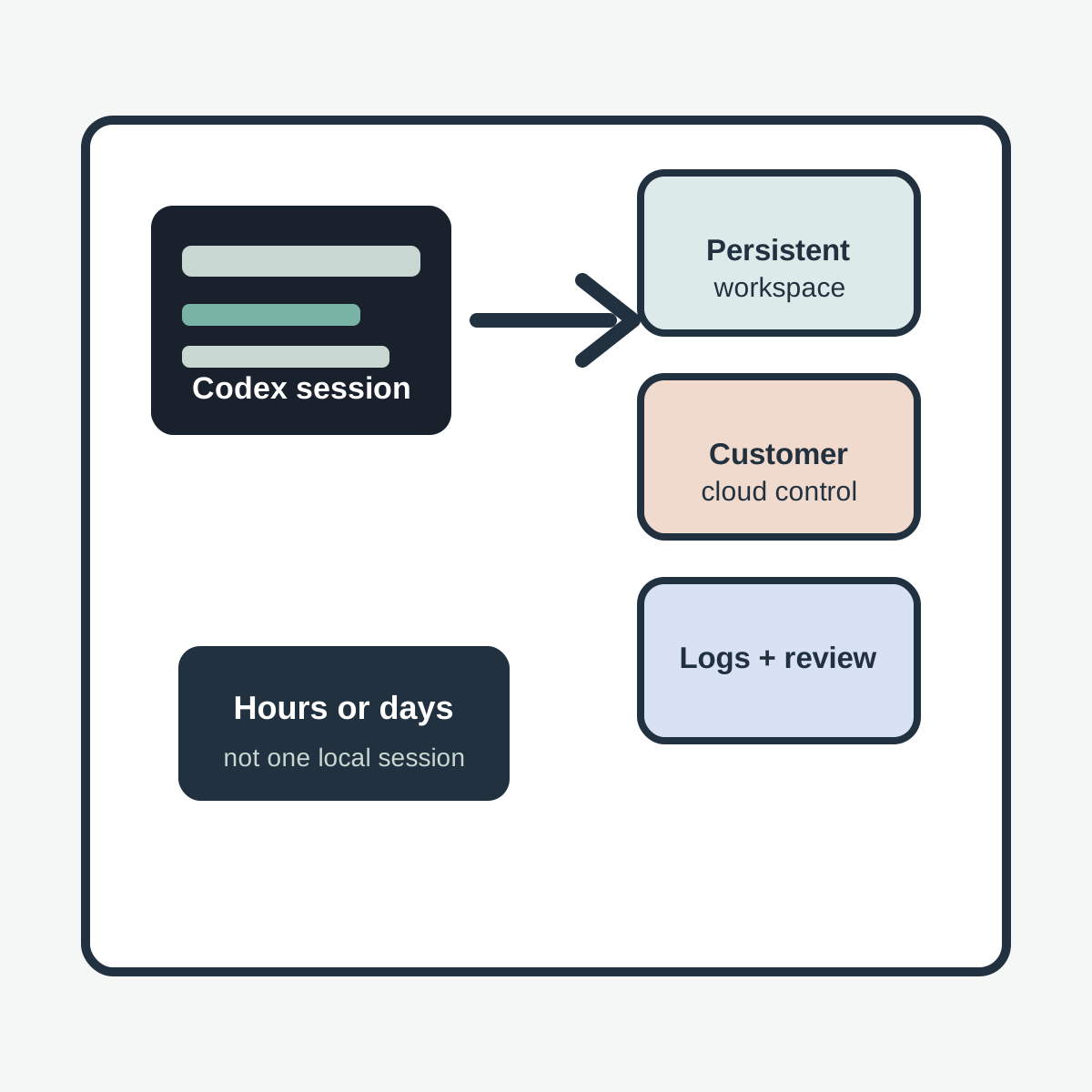
OpenAI says nearly a quarter of all Codex requests are for tasks estimated to take a person more than one hour. Among heavy daily users inside OpenAI, the 99th percentile regularly generated more than 60 hours of Codex agent turns per day by June 2026, spread across multiple parallel agents.
That number should be read carefully. OpenAI says task horizons are estimated with an LLM judge that has access to Codex transcripts, and the thresholds are directional rather than exact. Still, the direction is the point. Users are moving from asking for one answer to orchestrating many pieces of work.
This is why recent stories such as OpenAI’s Samsung deployment and Daybreak security work fit into a larger pattern. Codex is being sold and used as a work system, not only as a place to ask coding questions.
The caveat is measurement
OpenAI’s data is valuable because it comes from real usage, but it is not neutral market-wide evidence. It measures OpenAI’s own workforce, OpenAI users, and model-estimated task values. The company is both the researcher and the product owner.
That does not make the findings useless. It means they should be treated as a frontier-user case study. The strongest claim is not that every company will look like OpenAI. The stronger claim is that when capable agents are cheap enough, easy enough, and connected to tools, users begin assigning larger and more cross-functional tasks.
The next evidence to watch is outside OpenAI: customer task-completion data, admin controls, cost per completed workflow, and the failure modes that appear when non-developers run technical work at scale.
The work design question is now live
The economic question is no longer whether agents can help a developer write code. It is how organizations redesign work when agents can do pieces of analysis, tooling, migration, reporting, and support that used to sit between departments.
That will make governance harder. Teams will need review paths, audit logs, data controls, cost tracking, and training for people who are suddenly able to trigger technical execution. The upside is faster work. The risk is unreviewed automation spreading through business processes.
OpenAI’s article is useful because it gives that transition a measurable shape. Codex is becoming a default work surface inside OpenAI. The next test is whether other organizations can get the same leverage without importing the same blind spots.