OpenAI announced on June 11, 2026 that it plans to acquire Ona, a cloud development environment company, and bring its secure execution and orchestration technology into Codex.
The deal is not closed yet. OpenAI says it remains subject to customary closing conditions, including required regulatory approvals. Until then, OpenAI and Ona remain separate companies.
Codex needs a place to keep working
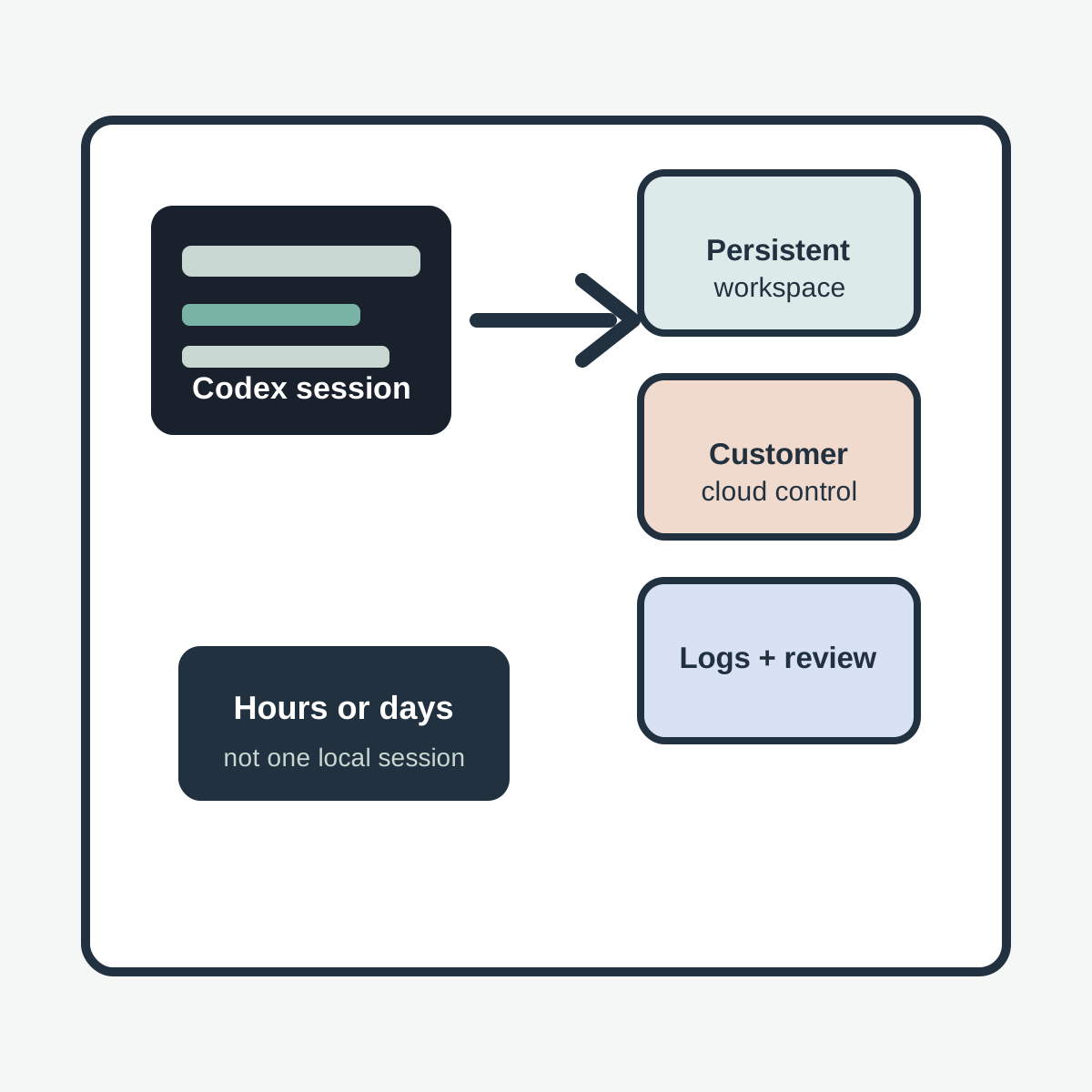
OpenAI’s stated reason for buying Ona is simple: the most valuable agent work is starting to take hours or days, not minutes. A coding agent that can only operate while one local session stays alive is poorly matched to long test runs, migration work, security remediation, or multi-step research.
Ona gives OpenAI a cloud-execution layer for that problem. OpenAI says Ona’s technology provides secure, persistent environments where agents can access the tools, systems, and context they need to keep making progress over time.
That changes the shape of Codex. A coding assistant can suggest a patch in a chat. A persistent agent needs somewhere to run commands, read logs, hold context, recover from interruptions, and wait for human review without being tied to a user’s laptop.
The numbers show why OpenAI is moving now
OpenAI says more than 5 million people use Codex each week, up 400% from earlier this year. It also says Ona has helped 2 million developers work in secure, reproducible cloud environments.
Those numbers frame the acquisition as infrastructure catch-up. Codex has enough usage that OpenAI now has to solve the operational layer around the model: persistence, access boundaries, auditability, and customer-controlled environments.
Enterprise agents are governance products
OpenAI’s post spends as much time on control as capability. It says organizations need to decide where agents run, what they can access, how credentials are scoped, how activity is logged, and how work moves through review.
That is the right emphasis. A long-running coding agent can touch source code, package registries, secrets, build systems, ticket queues, deployment scripts, and production-adjacent logs. The model may be the visible product, but the trust boundary is the system around it.
Ona’s customer-controlled execution model is meant to let agents run inside an organization’s cloud environment while OpenAI provides intelligence and orchestration. In plain terms, OpenAI wants Codex to do sustained work without forcing customers to give up control over the environment where that work happens.
What to watch after closing
The first thing to watch is what becomes available to customers. OpenAI has not published pricing, availability, cloud-region coverage, migration paths for Ona customers, or a product name for the combined Codex environment.
The second thing to watch is review flow. Persistent agents are useful only if humans can inspect work, redirect it, approve risky steps, and understand what happened after the fact. OpenAI’s post names logging and review as requirements; the implementation will matter more than the claim.
The third thing to watch is whether Codex becomes broader than software development. OpenAI says Codex now helps people research, analyze, build, and automate their work. Ona is a developer-infrastructure company, but persistent agent environments are useful anywhere an agent needs tools, files, credentials, and time.
For live model comparisons, see The AI Feed models page. For related company coverage, see OpenAI.