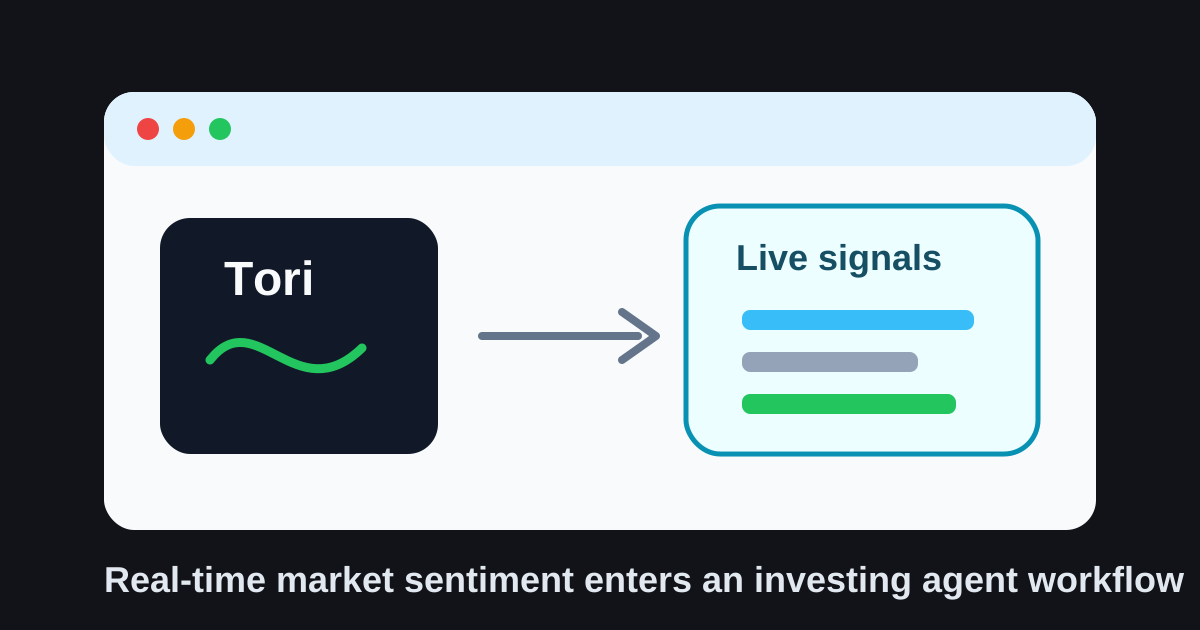
xAI says eToro’s Tori agent now uses SpaceXAI models to bring real-time market sentiment from X into an investing workflow. The company published the announcement on June 10, 2026.
The integration is narrow, but it shows the same pattern as xAI’s recent Gopuff Go launch: Grok is moving into partner products where real-time context is part of the job. In eToro’s case, the job is not filling a shopping cart. It is reading market mood, tracking live signals, and helping users analyze information while they are already inside an investing product.
Real-time context is the product claim
The core claim is not that Tori is a smarter general chatbot. xAI says Tori can use real-time information from X to read market moods as they shift. That makes the source of context central to the product.
Financial news, analyst notes, company filings, price action, and social chatter all move on different clocks. X is often early, messy, and noisy. That is useful only if the agent can separate a live signal from a rumor, joke, promotion, or coordinated spike. xAI’s post does not publish evidence that Tori can do that reliably, so the right read is cautious: the integration gives Tori a live signal channel, not a proven investment edge.
That still matters. Many consumer AI integrations sit beside the workflow. Tori is closer to the decision surface. A user asking about market sentiment inside eToro is likely closer to acting than a user asking a general assistant in a separate tab.
The second partner-agent story is different from Gopuff
xAI’s Gopuff Go story was about retail: preferences, carts, inventory, weather signals, voice, and image generation. The eToro story is about real-time text intelligence in a market setting. Both are partner-agent integrations, but the risk profile is different.
A bad shopping recommendation wastes time or money on a wrong basket. A bad investing interpretation can shape a financial decision. That does not mean the product should not exist. It means the assistant has to be careful about uncertainty, sourcing, and the difference between sentiment and advice.
Distribution is the strategic point
xAI says eToro has more than 40 million registered users across 75 countries. That number is the clearest business reason to pay attention. A model does not need to win only as a destination app if it can become a live context layer inside products people already use.
For xAI, the eToro integration also highlights X as infrastructure. Grok’s access to real-time X content is not only a consumer assistant feature. It becomes a selling point for enterprise and partner workflows that need current signals, especially where the user wants to know what changed now rather than what was true at training time.
The hard part is trust. If Tori summarizes market mood without showing enough basis, users may over-read the output. If it exposes uncertainty, disagreement, and freshness clearly, it can be useful without pretending to be an oracle.
What to watch next
The next useful evidence would be operational and compliance-focused: whether eToro shows source context, how Tori distinguishes sentiment from advice, what markets or assets it covers, and whether users can audit the signals behind an answer.
Until then, the narrow story is enough. xAI has put real-time X-aware models into a consumer investing agent with a large potential distribution surface. The feature’s value will depend less on whether it sounds current and more on whether it handles noisy, fast-moving information responsibly.
For live model comparisons, see The AI Feed models page. For related company coverage, see xAI.