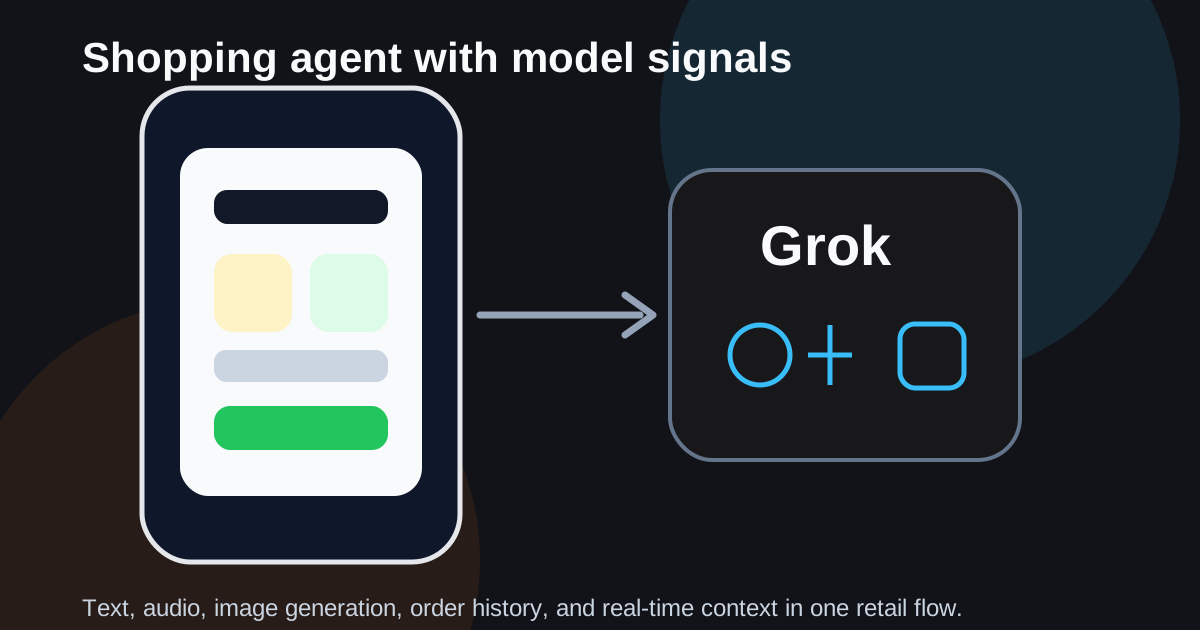
xAI says Grok 4.3 is now generally available on Amazon Bedrock. AWS posted the model’s availability on June 15, 2026, and xAI followed with its own announcement on June 17. The model card lists a 1-million-token context window, configurable reasoning, text and image input, and access through a Bedrock Mantle endpoint.
This is a distribution story more than a benchmark story. Grok is moving into the same enterprise procurement and governance layer where AWS customers already manage access to models from other providers. For xAI, that lowers adoption friction. For AWS, it adds another frontier model to Bedrock’s menu.
Bedrock changes the buyer surface
Buying a model directly from a lab is not the same as using it through a cloud model platform. Bedrock gives enterprises a familiar place to manage model access, APIs, accounts, regions, cost controls, and internal usage patterns. That can matter as much as raw capability for regulated or centralized IT teams.
AWS says Grok 4.3 is suited to customer support, web development, case law research, financial document Q&A, search, chat, and multi-turn workflows. Its documentation also describes Grok 4.3 as a reasoning-first model with tool use and instruction-following capabilities for multi-step agents.
The operator takeaway: xAI does not have to win every enterprise directly. It can win placement inside the catalogs enterprises already use.
The Mantle endpoint is part of the story
AWS says Grok 4.3 runs on Mantle, a Bedrock inference engine designed for price performance, with support for tool calling, structured outputs, and response streaming. The model card says programmatic access uses the bedrock-mantle endpoint and the model ID xai.grok-4.3.
That endpoint detail is not trivia. It means integration behavior can differ from other Bedrock models that use the standard Bedrock runtime path. AWS notes that Grok 4.3 is available on an openai/v1/responses path through bedrock-mantle, and that it supports Chat Completions and Responses APIs.
Developers should not assume a drop-in swap without reading the model card. The defaults also matter: AWS says Grok 4.3 uses a default temperature of 0.7, top_p of 0.95, and max_completion_tokens of 131072.
The claims still need sourcing discipline
xAI says Grok 4.3 has the lowest hallucination rate among frontier models and lists several benchmark wins. Those claims are useful context, but they should stay attached to xAI until the underlying benchmark pages are checked directly.
The stronger confirmed facts are distribution facts: Grok 4.3 is active in Bedrock, has a 1M context window in the AWS model card, supports configurable reasoning, and is available in us-west-2 at launch according to the regional table.
That is enough for an article. Enterprise adoption often happens through boring surfaces: supported regions, endpoint paths, IAM access, billing, quotas, and service tiers. Grok’s Bedrock listing is one of those surfaces.
What to watch next
The next checkpoint is usage evidence. Watch whether AWS or xAI names customers, publishes workload-specific case studies, or adds broader regional availability. A second checkpoint is whether Grok becomes available through more Bedrock APIs and service tiers over time.
The competitive question is also clear. Bedrock already sells choice as a product. Every additional frontier model makes the cloud catalog more valuable and makes direct model-vendor distribution less exclusive.
For readers tracking the model and company layers behind Grok, see our AI model leaderboard and xAI coverage through SpaceX.