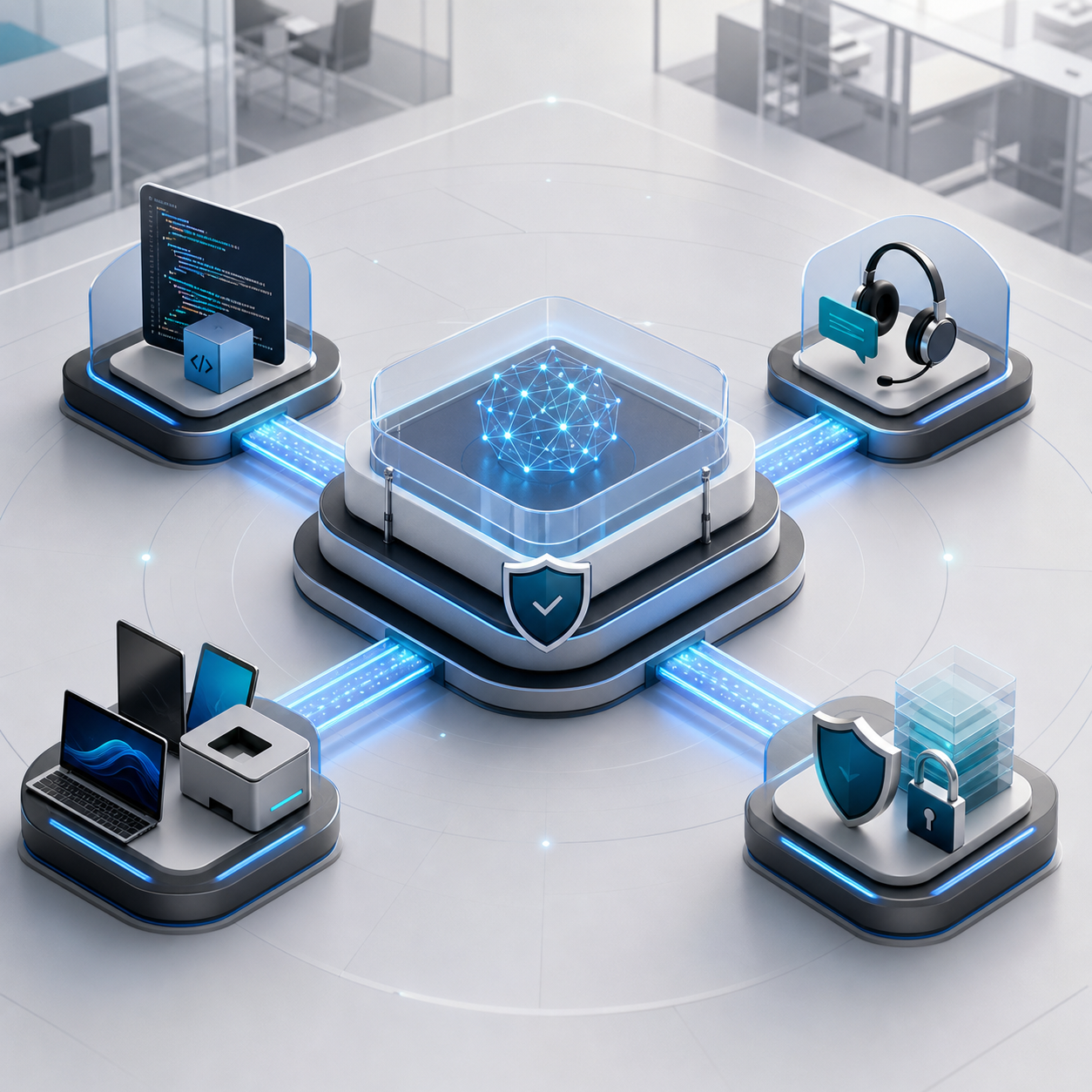
HP is scaling an OpenAI Frontier strategic partnership after several pilots across software development, security, customer operations, device management, and employee productivity. OpenAI published the HP partnership post on June 28, positioning Frontier as the connective layer for turning scattered AI pilots into governed enterprise workflows.
The concrete pilot examples are the useful part. OpenAI says one HP engineer used OpenAI models to move through 122 pull requests across 43 projects in a matter of weeks. It also says an HP security team used the models to remediate several software bugs in a day, work the team estimated could otherwise have taken up to a month. In another security note, OpenAI says the work unlocked a directional estimate of roughly 82 hours per week of security-team capacity.
Those figures are not universal productivity claims. They are HP and OpenAI examples. But they show why the partnership is moving from pilot language to operating-model language.
The story is governance, not only usage
Most enterprise AI programs start with scattered experiments. Someone uses ChatGPT for research. A developer tries Codex on a modernization task. A support team tests a chatbot. A security team asks a model to help summarize or fix an issue. The problem is that successful pilots do not automatically become safe production systems.
OpenAI says Frontier gives HP a way to understand what is running, what context each system can use, how actions are governed, and how outcomes are evaluated. That is the real enterprise layer. The question is no longer “can a model help this worker?” It is “can a large company know which agents are operating, what they are allowed to touch, and whether their results are improving?”
That is why the HP post spends so much time on context, permissions, evaluation, and reusable deployment patterns. AI tools become much more valuable when they can use internal context. They also become riskier. A code agent, support agent, or device-operations assistant needs access boundaries and review points before it becomes part of normal work.
HP has several workstreams
OpenAI describes several HP areas where Frontier is expected to apply. One is customer and partner-facing workflows. HP’s channel ecosystem is large, with OpenAI saying more than 80% of HP’s business flows through partners and more than 100,000 partners use the Partner Portal globally. The partnership aims to build more consistent self-service across store, partner, chat, and voice experiences.
Another workstream is HP’s Workforce Experience Platform. OpenAI says HP is exploring how device telemetry, support knowledge, operational objects, schemas, and runbooks can help AI reason across fleet-health signals such as crashes, Wi-Fi issues, and app hangs. That is a practical example because device management is full of repetitive diagnosis and known remediation paths, but it also requires careful grounding in real telemetry.
The security workstream is the clearest governance test. If AI helps remediate vulnerabilities, the company needs reviewable outputs, permissioning, and evaluation. Fast remediation is useful only if the fix is correct, scoped, and auditable.
ChatGPT and Codex sit inside a broader system
The post also separates ChatGPT and Codex work. OpenAI says HP is using ChatGPT for knowledge work such as research, analysis, ideation, and workflow automation, while Codex supports modernization, planning, UI scaffolding, and parallel software-delivery tasks.
That split is a good reminder that enterprise AI is not one tool. A general assistant, a coding agent, a support workflow, and a device operations assistant each need different context and controls. The common layer is the operating model around them.
For HP, the promise is less friction across everyday work. For OpenAI, the bigger strategic point is that Frontier is meant to make enterprise AI deployments repeatable. A pilot proves a use case. A platform decides whether the use case can be expanded without losing visibility.
The next proof is production evidence
The open question is how much of the HP program becomes regular production work and how much remains high-performing pilot evidence. The numbers in the post are encouraging, but they are still selected examples from early deployment.
The next useful evidence would be workflow-level results: how often agents are used, how many tasks are completed with human review, what error rates look like, how much work is rejected, and how teams measure quality over time.
The partnership is still worth covering now because it shows what major enterprise AI buyers are asking for. They do not only want model access. They want context, governance, evaluation, and a way to turn successful experiments into operating workflows.